
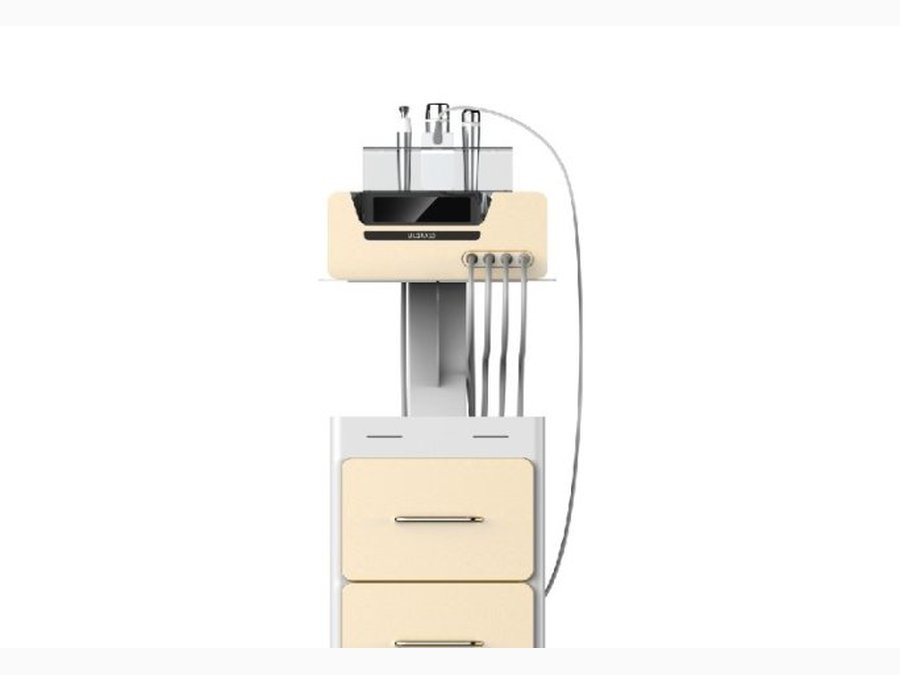
Key Engineering & Clinical Takeaways
- Acoustic Energy Focusing: A clinical-grade medical aesthetic HIFU device concentrates high-frequency acoustic waves (2 MHz to 7 MHz) through spherical concave piezoelectric ceramic transducers, generating discrete thermal coagulation points (TCPs) at 65°C–75°C at target depths without epidermal injury.
- Complete 7-Cartridge MMFU Architecture: Micro-focused facial cartridges (1.5mm, 2.0mm MF2 Slim, 3.0mm, 4.5mm SMAS) deliver precision dermal and SMAS lifting, while macro-focused body cartridges (6.0mm, 9.0mm, 13.0mm) induce targeted subcutaneous adipocyte apoptosis.
- 3-Phase Biological Healing Cascade: Thermal coagulation triggers immediate collagen fibril contraction, followed by acute inflammation, fibroplasia/neocollagenesis, and 90–180 day Type I collagen matrix remodeling.
- MF2 2.0mm Slim Transducer Precision: Engineered with a narrow 5.5 MHz transducer geometry for periorbital wrinkles, infraorbital laxity, and nasolabial folds where standard wide cartridges cannot maintain acoustic coupling.
1. Micro-Focused vs. Macro-Focused Ultrasound (MMFU) Physics
Modern 7D medical aesthetic HIFU device platforms integrate both Micro-Focused Ultrasound (MFU) and Macro-Focused Ultrasound (MaFU) within a unified piezoelectric driving architecture. Unlike monopolar radiofrequency, which heats broad tissue volumes via resistive current dispersion, focused ultrasound propagates mechanical pressure waves through the epidermis and upper dermis without thermal absorption until converging at the calibrated geometric focal point.
Facial micro-focused transducers operate at higher acoustic frequencies (4.0 MHz to 7.0 MHz), producing tight thermal coagulation zones measuring 0.5–1.0 mm³ for SMAS suspension and dermal tightening. Conversely, body macro-focused transducers operate at 2.0 MHz—reducing attenuation in deep tissue—to generate larger 2.0–4.0 mm³ focal zones capable of disrupting stubborn subcutaneous adipocytes at 6.0 mm, 9.0 mm, and 13.0 mm depths.
2. Complete 7-Cartridge 7D MMFU Depth & Frequency Protocol Table (1.5mm–13.0mm)
Accurate depth selection ensures energy lands inside the intended anatomical plane while avoiding superficial nerve branches and periosteum. Below is the complete 7-cartridge OEM clinical engineering specification:
| Cartridge | Frequency | Focal Depth | Focus Mode | Target Anatomical Layer | Primary Clinical Indications |
|---|---|---|---|---|---|
| L1.5 (1.5 mm) | 7.0 MHz | 1.5 mm | Micro-Focused | Superficial Papillary Dermis | Fine periorbital/forehead lines, pore texture, epidermal tone |
| MF2 Slim (2.0 mm) | 5.5 MHz | 2.0 mm | Micro-Focused Slim | Upper Reticular Dermis | Periorbital crow’s feet, infraorbital bags, perioral & forehead contours |
| L3.0 (3.0 mm) | 7.0 MHz | 3.0 mm | Micro-Focused | Deep Reticular Dermis | Mid-cheek dermal tightening, jowl compaction, neck elasticity |
| L4.5 (4.5 mm) | 4.0 MHz | 4.5 mm | Micro-Focused | SMAS Fibromuscular Layer | Lower-face lifting, jawline vector suspension, brow elevation |
| MF6.0 (6.0 mm) | 2.0 MHz | 6.0 mm | Macro-Focused | Submental & Shallow Adipose | Double chin contouring, bra-line & upper-arm adipose tightening |
| MF9.0 (9.0 mm) | 2.0 MHz | 9.0 mm | Macro-Focused | Mid-Subcutaneous Adipose | Flank sculpting, inner/outer thigh contouring, waist reduction |
| MF13.0 (13.0 mm) | 2.0 MHz | 13.0 mm | Macro-Focused | Deep Abdominal Adipose | Deep abdominal fat reduction (≥2.5 cm pinch thickness) |
3. 65°C–75°C Precision Thermal Coagulation: 3-Phase Biological Healing Cascade
Clinical efficacy in focused ultrasound depends strictly on reaching the 65°C–75°C thermal coagulation threshold within the focal zone while keeping surrounding tissue below 45°C. Crossing 65°C breaks heat-labile intramolecular hydrogen bonds within triple-helix collagen, initiating a three-phase regenerative cascade:
- Phase 1 — Immediate Contraction & Controlled Inflammation (Days 0–7): Instantaneous denaturation shrinks collagen fibrils by up to 30% along the SMAS vector, producing an early mechanical tightening effect. Macrophages and neutrophils infiltrate the microscopic TCPs to clear thermally coagulated debris and release TGF-β1 and FGF growth factors.
- Phase 2 — Fibroplasia & Type III Neocollagenesis (Weeks 2–8): Activated dermal and fascial fibroblasts synthesize pro-collagen, elastin precursors, and Type III reticular collagen matrix bridging the discrete thermal coagulation points.
- Phase 3 — 90–180 Day Matrix Remodeling & Type I Maturation (Days 90–180): Enzymatic cross-linking converts immature Type III collagen into high-tensile Type I collagen fibers, tightening the SMAS fascia and thickening dermal density for 12–18 months.
In macro-focused body cartridges (6.0mm–13.0mm), focal acoustic shear waves and localized hyperthermia rupture adipocyte membranes, triggering macrophage-mediated lipid clearance over 8 to 12 weeks. For clinics combining deep SMAS lifting with superficial dermal scar or pore resurfacing, practitioners routinely pair focused ultrasound with a medical aesthetic microneedling device.
4. Piezoelectric Transducer Longevity & OEM Quality Control
Transducer reliability relies on degassed acoustic coupling fluid, precision linear stepper motors for uniform 1.0–2.0 mm TCP pitch spacing, and automated impedance verification chips. Under ISO 13485 production protocols, every LEIJEX 7D MMFU cartridge undergoes hydrophone acoustic-field mapping and thermal tissue-phantom verification prior to shipment. Explore our medical aesthetics device platforms for OEM/ODM specifications.
5. Frequently Asked Questions (7D MMFU & HIFU Engineering)
Why is the MF2 2.0mm slim transducer essential on a medical aesthetic HIFU device?
The MF2 2.0mm slim cartridge features a narrowed acoustic window operating at 5.5 MHz, allowing flush skin contact along curved periorbital rims, tear troughs, and nasolabial folds where wider standard cartridges lose coupling and risk superficial blistering.
What is the optimal thermal coagulation temperature for SMAS lifting?
A focal temperature of 65°C–75°C is required to denature Type I collagen triple-helices and trigger the 3-phase neocollagenesis cascade without causing carbonization or unintended adjacent tissue necrosis.
How do 1.5mm–4.5mm facial cartridges differ from 6.0mm–13.0mm body cartridges?
Facial cartridges use 4.0–7.0 MHz micro-focused beams for tight dermal and SMAS coagulation points, whereas body cartridges use 2.0 MHz macro-focused beams that penetrate 6.0–13.0 mm to disrupt deep adipocytes.
 Leijex Medical